
Architecting Sovereign AI: Active Multi-Agent Defense and Deterministic Isolation
Traditional cloud-based AI wrappers treat developer-AI collaboration as a passive, non-deterministic chat loop. As engineering teams scale autonomous agent networks—running code generation, security audits, and schema migrations—relying on public, black-box APIs creates severe compliance, security, and developer experience bottlenecks.
In regulated spaces (finance, healthcare, legal), developers must balance speed with strict data protection guidelines like Singapore MAGF and regional PDPA rules. Forcing developers to push code to remote cloud environments just to run a validation check slows momentum. On the other hand, letting unconstrained agents execute code locally risks data leakage and system instability.
The solution lies in Sovereign AI Architecture: pairing local, hardware-accelerated execution with an air-gapped Active Multi-Agent Defense and Deterministic Isolation. This article explores the engineering blueprints of this architecture and how it prioritizes the Developer Experience (DevX).
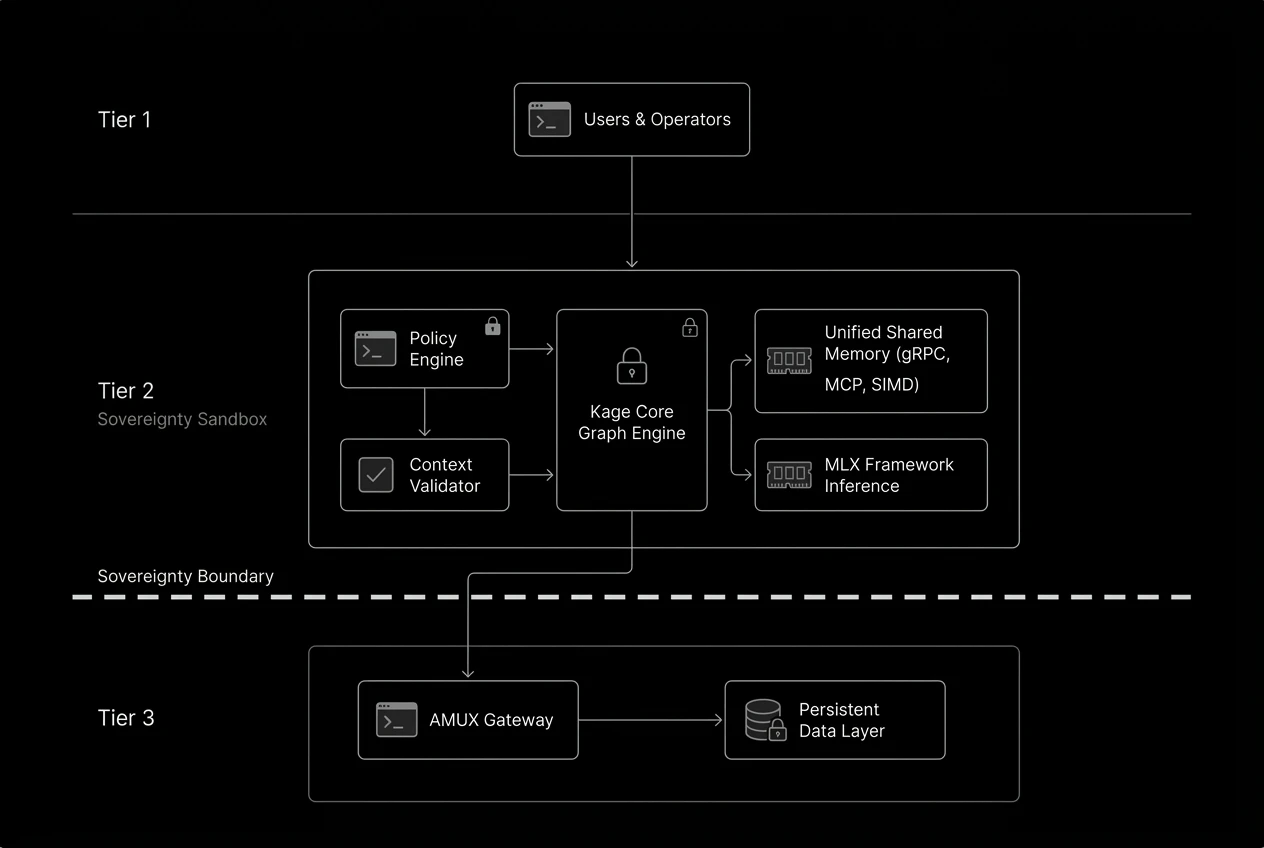 Figure 1.0: Sovereign Sandbox Blueprint. The multi-tiered architecture separating developer client utilities (Tier 1) and isolated local execution sandboxes (Tier 2) from external network Gateways (Tier 3).
1. The Developer Experience (DevX) Chasm in Enterprise AI
When building agentic workflows on public cloud models, developers face three major obstacles:
- The Compliance Friction Loop: If an agent changes its latent behaviors during an unannounced vendor update, developers must debug non-reproducible errors, stalling active sprint cycles.
- Latent Token Cost Drain: When testing local loops, recursive agent errors can go undetected, leading to runaway token consumption and high API bills before developers notice the loop.
- Data Residency Blocks: Security policies prevent developers from uploading raw proprietary codebases or sensitive client data to third-party public vectors, limiting their ability to test agents on real-world datasets.
To bridge this chasm, modern software factories must bring the infrastructure to the developer. By running optimized open-source weights locally on developer workstations (leveraging Apple Silicon unified memory via the Apple MLX Framework), engineers gain a zero-latency, offline sandbox.
2. In-House Architecture: The Sovereign Sandbox
The developer workflow operates inside an isolated, containerized workspace (Tier 2). Rather than relying on external guardrails, the sandbox integrates three core in-house modules directly into the local loop:
A. The Local Policy Engine
Integrates directly with the developer’s local CLI (e.g. bitstric devx scan) and IDE plugins. It evaluates proposed agent actions against structured rulesets locally on the workstation, providing sub-millisecond lint-style compliance feedback before code leaves the developer’s terminal.
B. Project Kage Core (Agentic Graph Middleware)
An asynchronous graph engine that hosts active agent states in shared system memory (the Graph Arena). Kage Core parses and validates agent actions using SIMD-accelerated lexers, maintaining a real-time map of repository dependencies and execution trees.
C. The Context Validator
Monitors data flows between Kage Core and local inference runners (such as Ollama or Whisper.cpp). If an agent attempts to expose unmasked customer PII or introduce an unverified API dependency, the Context Validator blocks the transaction and places the active container into durable hibernation, saving the graph state without crashing the developer's local environment.
3. High-Performance Local Ingress
To ensure that real-time developer workflows are not slowed down by compliance checks, the sandbox uses low-overhead system interfaces:
- Memory-Mapped I/O (
mmap): Pointer-chased graph arenas are mapped directly to shared system memory, enabling local query latency targets of under 1.2 ms. - Kernel Sockets (
io_uring): Developer CLI commands interface with the graph middleware daemon via local Unix sockets usingio_uringkernel pools, reducing context-switch latency to under 0.4 ms (see the Linux io_uring Performance Whitepaper). - Standardized Interfaces: Integrates with the open Model Context Protocol Specification, standardizing data exchanges between local developer tooling, IDEs, and local agent sandboxes.
4. The Separation Gateway: Data Sovereignty Boundaries
To preserve strict compliance, the local sandbox (Tier 2) is completely air-gapped from the public cloud. Data exchanges crossing the boundary (Tier 3) are governed by the AMUX Gateway:
- OpenAI-Compatible Proxying: The AMUX Gateway (configured via LiteLLM Proxy Router) translates inbound queries into compliant, system-level token arrays, isolating external networks from internal databases.
- The local Provenance Ledger: Every validation checkpoint and approved delta modification is written to an immutable local ledger. This logs a cryptographically signed audit trail to support SOC-2 compliance reviews.
- Consensus Syncing: Local graph modifications (deltas) are distributed across developer nodes using the Raft Consensus Protocol, ensuring all workspaces remain synchronized with the latest ontology rulesets without pooling raw source data in a single location.
5. Conclusion: Empowering Developers through Secure Autonomy
By bringing sovereign AI execution to the developer's local workstation, enterprises eliminate the friction of distant compliance checks. Active multi-agent defense and deterministic sandboxing allow developers to write, test, and deploy agentic workflows with the speed of local hardware and the safety of air-gapped networks.
Standardizing developer experience on local, ontologically anchored sandboxes turns security from an operational bottleneck into a competitive advantage, accelerating software factory yield while maintaining complete data governance.
To learn more about local orchestration frameworks, explore the Open WebUI Project or check out the W3C OWL Web Ontology Language Standards.