

Why Public Models Fail the Financial Audit Trail Requirement
Enterprise financial operations demand absolute predictability, trace-level accountability, and mathematical replicability. Under strict regulatory frameworks—such as SEC Rule 17a-4, MiFID II, and regional standards like the Monetary Authority of Singapore (MAS) Guidelines on Risk Management—every transaction, recommendation, and risk assessment must be reproducible and trace-verify.
As organizations rapidly deploy autonomous AI agents to manage portfolios, automate treasury reconciliations, and handle compliance auditing, they face a critical architectural challenge: public, black-box APIs fail to meet the core requirements of a financial audit trail.
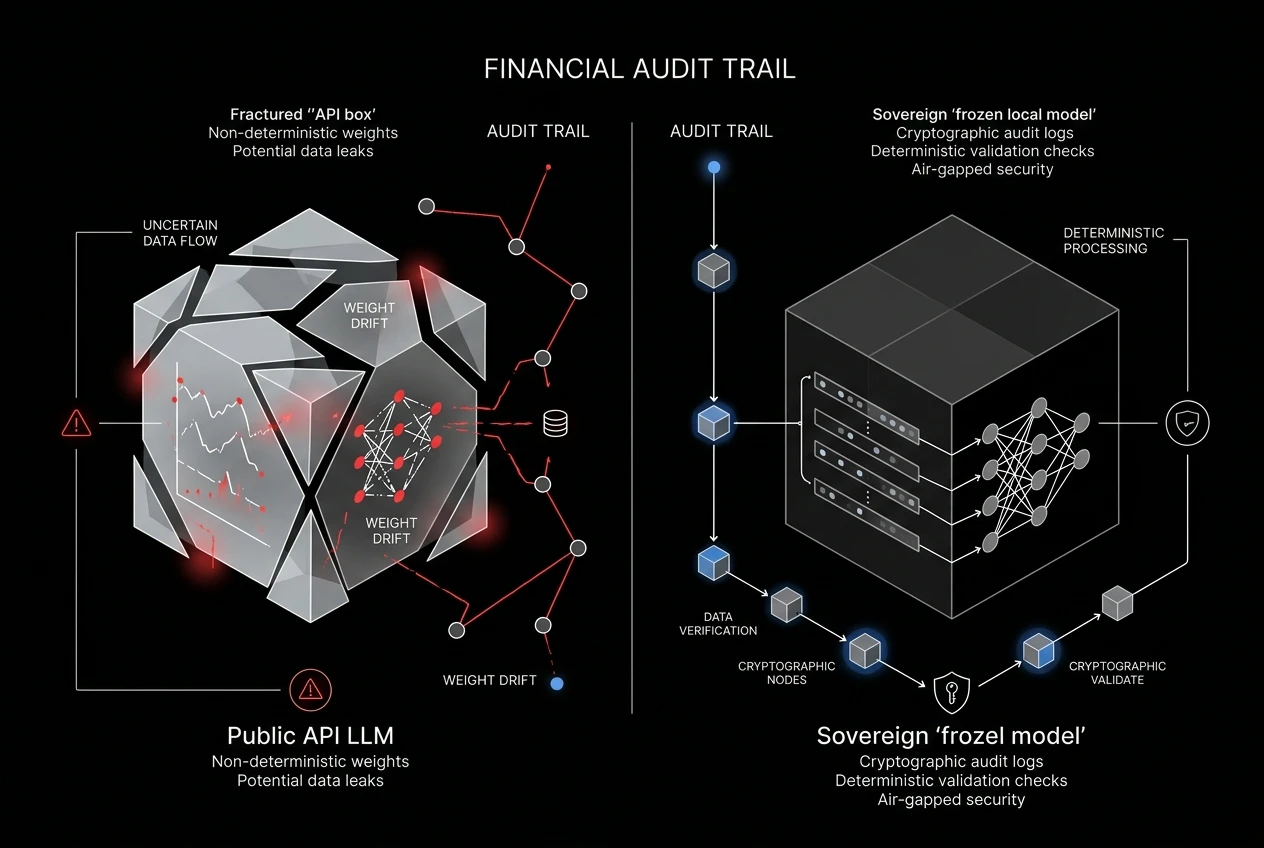 Figure 1.0: Financial Audit Trail Comparison. The non-deterministic drift of public APIs (left) versus the stable, cryptographically verifiable processing of a local sovereign AI platform (right).
1. The Traceability Challenge: Model Drift and Non-Determinism
The primary failure mode of public model APIs in regulated environments is non-determinism. Large Language Models (LLMs) are probabilistic token predictors. Even when temperature settings are locked at zero, public API providers run rolling, unannounced updates, RLHF (Reinforcement Learning from Human Feedback) optimization iterations, and performance tuning behind the scenes.
Consequently, the underlying latent weights of the model shift dynamically. An agent processing a specific market condition or credit risk profile at 10:00 AM might execute a completely different action when presented with the exact same input at 2:00 PM.
In financial audits, this unpredictability is a disqualifying risk:
- Loss of Non-Repudiation: If an auditor requests a trace of why an agent authorized a transaction or flagged a portfolio, it is impossible to reconstruct the exact model state if the weights have drifted.
- Inexplicable Decision Trees: Public black-box APIs do not expose token-level logic or internal validation matrices, leaving risk officers unable to prove compliance with internal policies.
- API Egress Violations: Sending transaction data to external multi-tenant servers violates customer confidentiality standards and data residency requirements under local personal data protection laws.
To maintain compliance, enterprises must shift from volatile, external models to stable, sovereign local infrastructures where execution loops can be formally audited.
2. Three Pillars of Audit-Ready AI Infrastructure
To guarantee verifiable audit paths, enterprise engineering groups must transition to an on-premise or sovereign private cloud strategy. By running fine-tuned, open-source models inside a fully controlled infrastructure cluster, companies gain absolute control over model state, data privacy, and system governance.
A. Frozen Model States
By hosting models locally (e.g. running optimized open-source weights on private Linux servers or Apple Silicon local clusters), organizations lock model weights. This guarantees 100% reproducibility: the model will process identical financial profiles identically, regardless of when the transaction is initiated.
B. Deterministic Guardrails (Ontological Anchors)
Before an agent's output is executed or written to a database, the payload must pass through local compliance gateways and schema validation engines. These rule filters test the proposed action against strict regulatory taxonomies (e.g. checking for unencrypted account identifiers or unauthorized credit thresholds) and block out-of-bounds actions.
C. The Local Provenance Ledger
Every step of the agent's execution—including the exact input tokens, the validation gate signatures, and the output states—is written to an immutable local ledger. Signed with hardware-isolated private keys, this ledger provides auditors with a tamper-proof, chronological record of every system decision.
3. Sovereign Infrastructure Offerings
Building a compliant financial audit trail relies on aligning local developer tools with enterprise network boundaries:
- Sovereign Runtime Audits: Deep-dive inspections of project dependency trees, API routes, and local workspaces to isolate data-leakage vulnerabilities.
- Sovereign Middleware Integration: Deploying local checkpointers, confidence-threshold gaters, and gRPC schema pipelines into private virtual networks.
- Compliance SLA Governance: Continuous tracking of token budgets, replication latency, and automation metrics via localized dashboards.
4. Quality Gates & Staging Protocols
Deployments must systematically verify that all technical controls yield a green state prior to production activation:
- Synthetic Verification Networks: All initial system tests and rule configurations must execute inside isolated staging networks. Staging runs are blocked from accessing live client production databases to prevent data leaks.
- Cryptographic Log Enforcement: The compilation engine blocks container deployment if the runtime script is missing non-nullable hash arrays, ensuring session histories remain tamper-proof.
- Decoupled SLA Frameworks: Infrastructure design and compliance rules mapping operate within a private, advisory phase. Once live production workflows are enabled, operations transition to isolated sandbox environments governed by legally decoupled, SLA-backed service layers.
5. Key Takeaways
- Eliminate Vendor Drifts: Lock model weights locally to achieve highly predictable, reproducible behavior patterns.
- Zero Leakage Perimeters: Keep customer positions, portfolio data, and trade logic completely isolated from external networks.
- Resilient Compliance Architecture: Meet stringent financial data protection standards out of the box.
Take Total Ownership of Your AI Stack: Migrate away from unreliable public APIs and deploy secure, localized agent networks. → Speak with our Infrastructure Architects