
Deterministic Ontologies: The Trust Anchor for Sovereign Agentic AI
"Neural networks operate in the space of probabilities; enterprise operations demand the absolute certainty of logic. To bridge the chasm between probabilistic inference and deterministic compliance, sovereign agentic AI must anchor its runtimes in mathematically verified, structured ontologies."
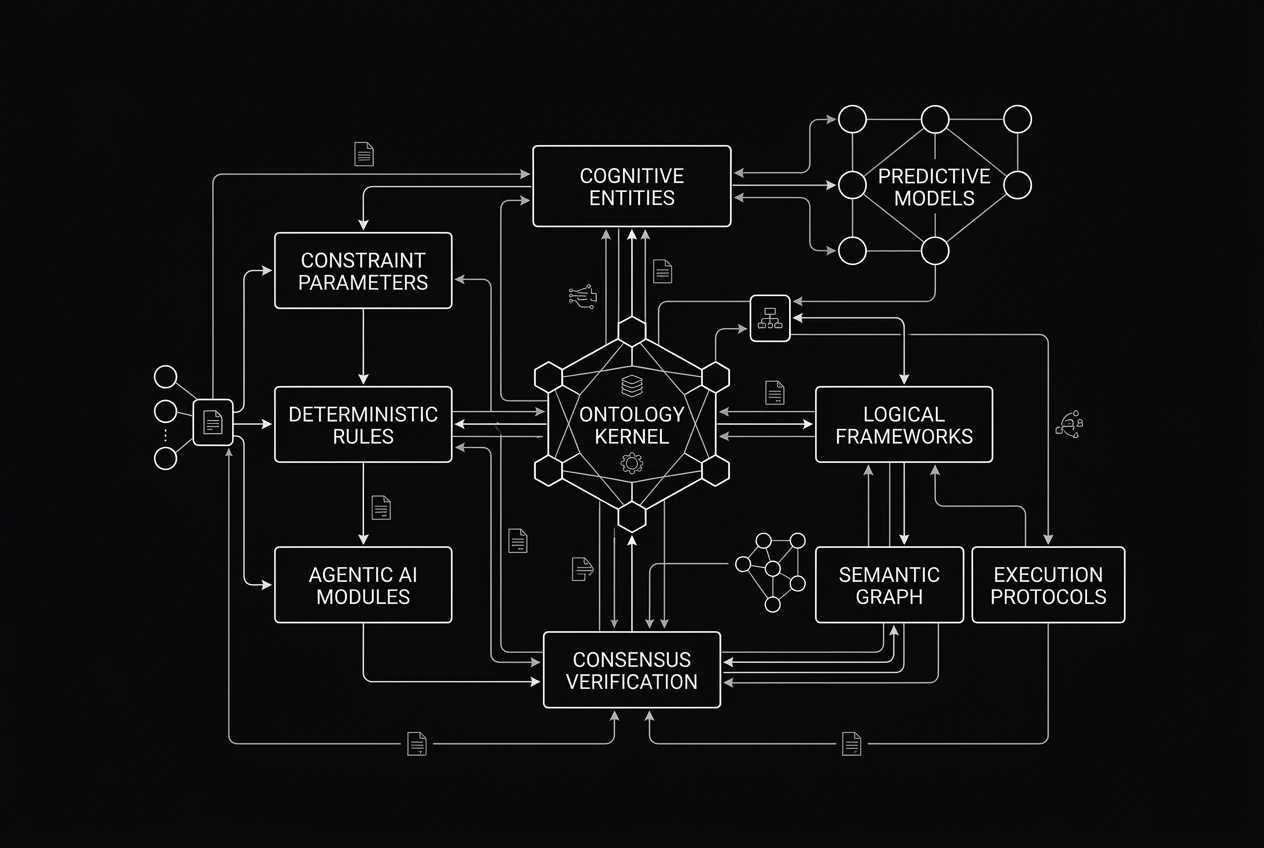 Figure 1.0: Deterministic Ontology Network Architecture. A visual mapping of ontological kernels constraining local cognitive runtimes, logical frameworks, and predictive models.
The Chaos of Non-Deterministic Agency
In the rapid evolution of enterprise artificial intelligence, the transition from simple query-response Large Language Models (LLMs) to autonomous, long-running agentic graphs has introduced a critical structural vulnerability: the dependency on non-deterministic execution.
Traditional AI agents, powered by generative networks, navigate workflows by predicting the next logical token or step. When applied to complex, high-stakes tasks—such as procurement auditing, legal contract synthesis, or financial ledger reconciliation—this probabilistic approach is a liability. Generative models are susceptible to hallucination, schema drift, and unexpected execution paths. In regulated sectors (such as healthcare, banking, and public safety), a single out-of-bounds agent action can violate data compliance standards, corrupt databases, or trigger financial reporting breaches.
Furthermore, typical software wrappers attempt to govern agents by streaming raw execution logs to human operators. When an agent encounters a low-confidence decision, the supervisor is presented with thousands of tokens of step-by-step reasoning, raw JSON outputs, and trace logs.
This results in the Context-Switching Tax—an operational bottleneck where managers suffer cognitive fatigue trying to rebuild the agent's context. Research in cognitive science indicates that a developer or manager takes an average of 23 minutes to return to deep focus after an interruption, severely impacting team productivity.
To scale agentic ecosystems without collapsing operational teams or risking compliance failures, enterprises must pivot from passive chat logs to Deterministic Ontologies. By anchoring local agent loops within a defined, mathematically verified schema of entities, rules, and allowed transitions, the system guarantees that agents cannot execute actions outside of authorized operational boundaries.
The Architectural Pivot
The following matrix contrasts the vulnerabilities of legacy agent wrappers with the safeguards of the sovereign, ontologically anchored model:
| Probabilistic Agent Wrappers (Legacy) | Deterministic Ontological Anchor (Sovereign) |
|---|---|
| Probabilistic Trajectories: Agents navigate workflows by predicting next-step actions, leading to non-deterministic edge cases. | Constrained Trajectories: Agents propose state updates within a mathematically verified domain graph, preventing out-of-bounds actions. |
| Raw Log Dumps: When validation fails, human operators must review raw JSON text streams and trace logs to diagnose errors. | Flash Review Workspaces: Systems isolate variables, displaying proposed outputs against triggered business rules in under 30 seconds. |
| Compute Cost Leakage: Runtimes continuously execute background loops while awaiting human verification, draining API tokens. | Durable Graph Hibernation: Memory state is serialized and the container sandbox is put to sleep during the human review window. |
| Pooled Data Risks: Centralizing sensitive files into cloud vector graphs to achieve global intelligence, risking data leaks. | Knowledge Delta Mesh (KDM): Syncing cryptographically signed, local graph mutations with zero raw data pooling. |
The Mathematical Foundation
To achieve verified execution, we define the sovereign agentic boundary through a formal relational expression:
$$\text{Ontological Schema } (\Omega) ;\sqcap; \text{Local Inference } (\Phi) ;\Longrightarrow; \text{Deterministic Agent } (\Psi)$$
Where:
- $\Omega$ (Ontology Kernel): Represents the strict, immutable taxonomy of entities, rules, and allowed transitions.
- $\Phi$ (Local Inference Loop): The probabilistic token engine (e.g. Apple MLX) proposing candidate steps.
- $\Psi$ (Deterministic Agent): The verified execution output, guaranteed to operate strictly within the bounds of the ontology schema.
The Sovereign AI Integration Blueprint
The entire Sovereign AI platform combines custom, high-performance binary modules with targeted, production-hardened open-source software (OSS) foundations to eliminate redundant development cycles and maintain data residency:
┌──────────────────────────────────────────────────────────────────────────┐
│                   ENTERPRISE GOVERNANCE & MESH LAYER                     │
│  [Custom] Knowledge Delta Mesh       │ [Custom] Compliance Gateway       │
│  [OSS]    Open WebUI (Turnkey UI)     │ [OSS]    LiteLLM (Proxy Router)   │
├──────────────────────────────────────┴───────────────────────────────────┤
│                   MIDDLEWARE & ORCHESTRATION ENGINE                      │
│  [Custom] Kage Core (Thread-Per-Core Asynchronous Graph Engine)         │
│  [OSS]    Model Context Protocol (MCP) Server Framework                  │
│  [OSS]    Raft Protocol Engine (Consensus Manager)                       │
├──────────────────────────────────────────────────────────────────────────┤
│                   LOCAL EDGE EXECUTION RUNTIME                           │
│  [Custom] Nomadic Local CLI / Kernel Guardrail Engine                    │
│  [OSS]    Apple MLX Framework (Unified Memory Acceleration)              │
│  [OSS]    Ollama Daemon Core / Whisper.cpp (Local Inference)             │
└──────────────────────────────────────────────────────────────────────────┘
Complete Component Stack:
- User Interface (Open WebUI Project): Deployed as a containerized web interface to ensure immediate access for enterprise operators without web development overhead.
- API Gateway & Proxy (LiteLLM Proxy Router): Provides an OpenAI-compatible interface structure that translates inbound payloads into explicit, system-level token arrays.
- Knowledge Graph Engine (Kage Core): An asynchronous, single-binary middleware daemon running thread-per-core architectures. It uses SIMD-accelerated lexers to map knowledge updates directly into shared memory.
- Integration Interface (Model Context Protocol Specification): Standardizes data exchanges between local developer tooling, edge agents, and internal microservices.
- Edge Compute Optimization (Apple MLX Framework): Drives hardware acceleration across Apple Silicon unified memory channels, outperforming multi-GPU consumer configurations for large-parameter tracking workloads.
- Inference Compute Daemon (Ollama Engine Core & Whisper.cpp): Handled as a downstream subprocess by local CLI engines to process local token generation loops.
Tracing the Knowledge Delta Mesh (KDM)
The Knowledge Delta Mesh (KDM) resolves knowledge fragmentation in sovereign deployments by packaging and distributing graph mutations instead of raw documents. The following sequence diagram outlines the transaction path when a local developer node (running compliance checks) triggers a validation update and synchronizes it across target nodes:
sequenceDiagram
    autonumber
    participant Dev as Developer / CI/CD (Local Lint / Scan)
    participant Edge as Sandbox Container (Code-Runner / QuickJS)
    participant Mid as Middleware (Confidence Gater & Checkpointer)
    participant SLA as Cognitive SLA Router
    participant App as Application Layer (Flash Review Canvas)
    participant Mgr as Compliance Reviewer (Manager)

    Dev->>Edge: Trigger Local Agentic Task (Refactor / Audit)
    Edge->>Edge: Run Local Lint & Rules Audit (MAGF/PDPA Rules)
    alt Validation Score >= 85%
        Edge->>Dev: Direct Run Success (Compile Provenance Stamp)
    else Validation Score < 85% (PII Warning / Schema Drift)
        Edge->>Mid: Forward Trace State & Block Alert
        Mid->>Mid: Serialize Graph State & Hibernate Staging Container
        Mid->>Mid: Distill Log via ELI5 Summarizer
        Mid->>SLA: Queue Attention Alert & Start 15-Min SLA
        SLA->>App: Route Alert to Attention Dashboard
        App->>Mgr: Display Flash Review Canvas & Localized Facts
        Note over Mgr: 30-Sec Decision Loop
        alt Manager responds in time
            Mgr->>App: Actions: [Approve | Override | Pivot]
            App->>Mid: Return Decision with Cryptographic Signature
        else SLA Timeout (>15 mins)
            SLA->>SLA: Escalate & Route to Alternate Review Matrix
            App->>Mid: Return Escalated Decision with Signature
        end
        Mid->>Mid: Validate Signature & Write to Provenance Ledger
        Mid->>Edge: Release Sandbox Hibernation & Resume Loop
        Edge->>Dev: Complete Task & Print Verification Stamped Hash
    end
Detailed Execution Steps:
- Delta Extraction: KDM tracks incremental mutations within Kage Core's pointer-chased memory allocation system (the Graph Arena). When local agent execution loops update knowledge edges, KDM isolates these graph delta modifications.
- Cryptographic Packaging: The isolated graph differences or localized fine-tuning layers (such as Low-Rank Adaptation matrices generated via Apple MLX) are packaged into binary payloads. They are paired with a hash of the current cluster base state to prevent out-of-order schema mutations.
- Signature Verification: Payloads are signed using hardware-isolated private keys (via the Apple Secure Enclave or an on-premises HSM) using Ed25519 signatures.
- Distribution Layer: The signed delta is broadcast to verified cluster endpoints over a gRPC stream using UNIX domain sockets locally or via TLS over an external network mesh.
- Ingress Merge: Recipient nodes verify the signature against an authorized tenant registry. Once validated, the delta is direct-mapped into Kage Core’s active Adjacency Matrix using low-overhead I/O calls (Linux io_uring Performance), bypassing deep JSON text parsing entirely.
The Flash Review & Cluster Sync Dashboard
This Terminal User Interface (TUI) representation shows the cluster sync monitor where operators track incoming knowledge deltas, verify signatures, and inspect graph arena capacity in real-time:
┌────────────────────────────────────────────────────────────────────────┐
│  🧠 SOVEREIGN KDM INTERFACE - CLUSTER SYNC MONITOR (ACTIVE-CORE)       │
├────────────────────────────────────────────────────────────────────────┤
│ CLUSTER: sovereign-cluster-01     │ REPLICATION ENGINE: Raft Protocol  │
│ STATUS: ACTIVE SYNC               │ CORE INGRESS ENGINE: io_uring      │
├───────────────────────────────────┴────────────────────────────────────┤
│ [KNOWLEDGE DELTA TRANSACTION LOG]                                      │
│ ID          SOURCE NODE  SEQUENCE  LATENCY  STATUS    VERIFICATION     │
│ TXN-984A    Node-M5-01   #00984    0.8 ms   MERGED    Ed25519-Enclave  │
│ TXN-984B    Node-M4-03   #00985    1.1 ms   MERGED    Ed25519-Enclave  │
│ TXN-984C    Node-M5-02   #00986    2.3 ms   PENDING   Raft-Consensus   │
│                                                                        │
│ [ACTIVE GRAPH ARENA STATS]                                             │
│ > Total Nodes Joined: 12 / 12 (Max capacity reached)                   │
│ > Shared Pointer Arena Size: 48.5 GB / 128 GB                          │
│ > Active Rulesets: SG-MAGF, Malaysia-PDPA, SOC-2                       │
│                                                                        │
│ [LOCALIZED CONTEXT MAP (ELI5 KDM SYNC)]                                │
│ "Node-M5-01 generated a local LoRA model delta mapping a refactored    │
│  API schema for /api/v1/ledger. The KDM extracted the graph difference,│
│  signed it via Apple Secure Enclave, and merged it into shared memory  │
│  in 0.8 ms using SIMD Radix Token Trees."                              │
├────────────────────────────────────────────────────────────────────────┤
│ ACTIONS (Press [S] Force Sync | [V] Verify Signatures | [C] Cluster Config)│
└────────────────────────────────────────────────────────────────────────┘
Figure: The Sovereign Knowledge Delta Mesh Monitor, designed for real-time tracking of cryptographic graph delta replications and I/O latency targets using the Raft Consensus Protocol.
Program Architecture & Offerings
Sovereign DevX and KDM capabilities map directly onto structured capability levels, aligning local tools with enterprise network requirements:
| Offering Category | Core Technical Deliverables | Core Development Roles | Enterprise Value |
|---|---|---|---|
| Attention Readiness Audit | Cognitive bottleneck inventory, attention leakage maps, and a 30-day runtime optimization matrix. | Delivery Lead, Integration Engineer, Solutions Architect | Maps existing agent runtimes, identifies schema drift hotspots, and establishes the compliance ruleset baseline. |
| Attention-Budget Integration | Middleware compilation, Confidence-Threshold Gater setups, and gRPC schema checkpoint pipelines. | Lead Engineer, Solutions Architect, Integration Engineer | Establishes the gRPC/WebSocket schema boundaries, registers local checkpointers, and hooks up the container hibernation API. |
| Cognitive SLA Framework | Continuous router maintenance, token tracking, monthly Automation Yield audits, and executive summaries. | Delivery Lead, Lead Engineer, Support Operator | Manages the dynamic routing matrix, audits multi-agent token spend, and tracks SLA queue latency curves. |
Staged Quality Gates & Decoupled SLAs
Prior to moving workspaces, code-refactoring pipelines, or KDM nodes to production, three quality gates must be verified:
- Live Verification Exclusion: To ensure absolute security and prevent unintended leakage, all integration scripts, validation rules, and agent runtimes must execute inside mock synthetic networks. Staging runs are blocked from accessing live client production databases.
- Cryptographic Log Enforcement: The validation engine blocks container compilation if the runtime script is missing non-nullable hash arrays. Session histories are stored in the local Provenance Ledger, creating a tamper-proof audit trail for regulatory audits.
- Decoupled SLA Frameworks: Infrastructure design and rules mapping operate within a private, advisory phase. Once live production workflows are enabled, operations transition to isolated sandbox environments governed by legally decoupled, SLA-backed service layers to maintain regulatory compliance.
Focus and Structure as a Sovereign Moat
Building autonomous agents is no longer the primary differentiator. The true competitive moat is building the deterministic infrastructure that allows developers, managers, and agents to collaborate without friction or compliance exposure.
By integrating Sovereign DevX Automation with the Knowledge Delta Mesh, organizations can confidently scale their multi-agent runtimes, protect engineering capacity, and isolate regulatory and token cost risks.
By treating attention and knowledge replication as structured, cryptographically secure assets, modern software factories can turn cognitive focus and node autonomy into their primary competitive advantage.
For more details on semantic graph boundaries and semantic web standards, refer to W3C OWL Ontology Specification.